Polyjacking wins for most Northeast Pennsylvania homes. Mudjacking costs less upfront, but the cement slurry typically lasts only 3 to 5 years, takes 24 to 72 hours to cure, and adds hundreds of pounds to soil that is already settling.
Polyjacking costs more per job, but the polyurethane foam cures in about 15 minutes, lasts for decades, and weighs a fraction as much. If you plan to stay in your home, polyurethane concrete lifting is the better buy.
In this comparison, you will learn how each method works, where each one makes sense, and why NEPA’s freeze-thaw winters and mine-affected soils tilt the decision toward foam.
Get My Free Concrete Lifting Estimate in NEPA Today
What Is Mudjacking?
Mudjacking is the older method of concrete leveling. A contractor drills holes in the sunken slab and uses a hydraulic pump to push a slurry of Portland cement, sand, and other additives underneath it. The slurry fills the void and lifts the concrete.
The method has been around for decades, and plenty of companies still offer it because the materials are cheap and the equipment is simple. That is exactly why the low quote looks tempting.
The tradeoffs come after the crew leaves.
- The slurry breaks down over time. Most mudjacking repairs last about 3 to 5 years before the slab starts settling again.
- The material cures slowly, typically 24 to 72 hours, so the surface is out of service for days.
- The pump forces hundreds of pounds of heavy slurry under the slab, which adds load to the very soil that failed, and can damage buried utilities.
- The injection holes are larger and more noticeable than the holes polyjacking leaves behind.
What Is Polyjacking?
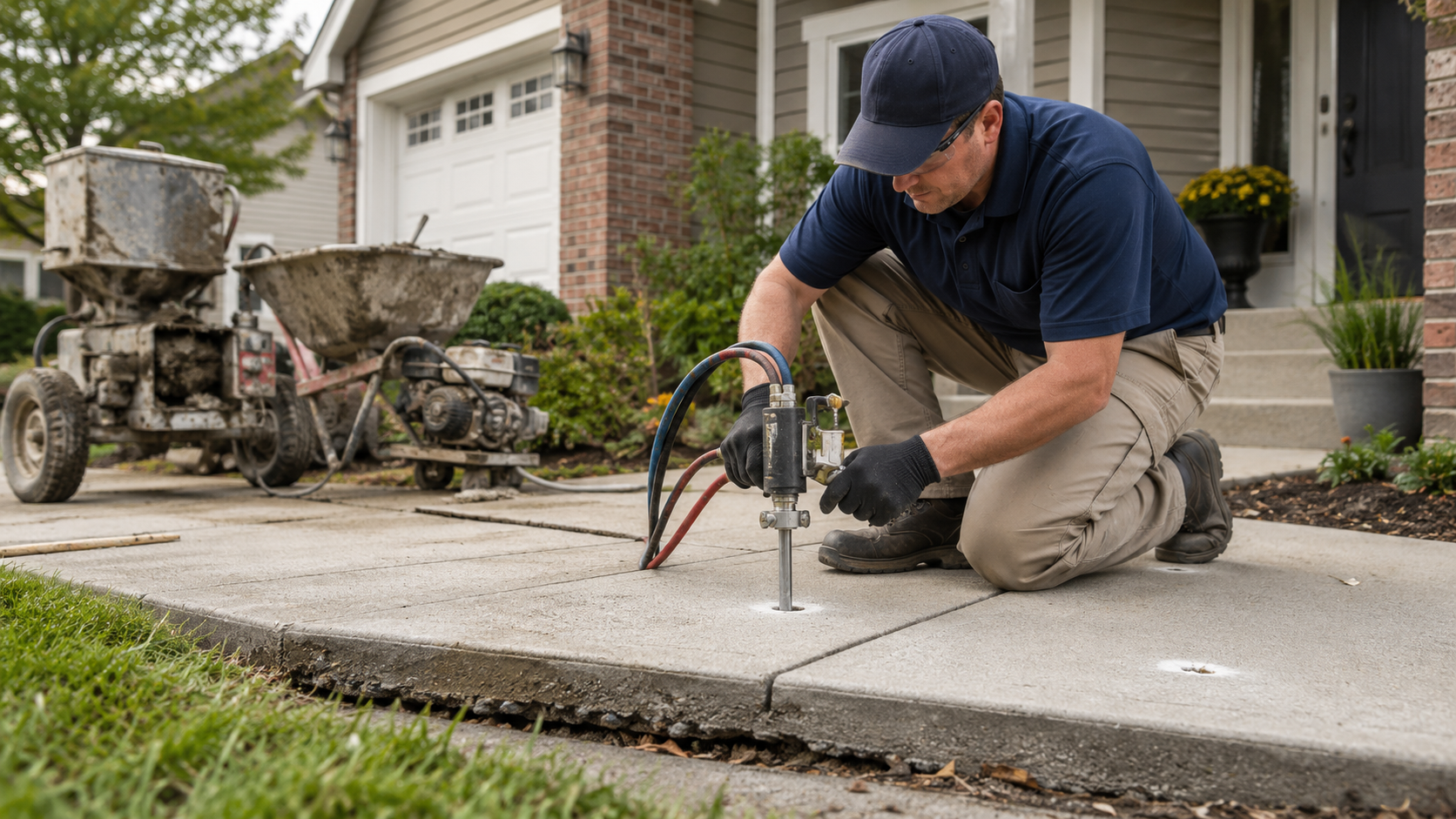
Polyjacking is the modern method. A technician drills a few small holes, each about 5/8 of an inch across, roughly the size of a dime, and injects an expanding polyurethane foam under the slab.
The foam flows into the voids, expands, and lifts the concrete in controlled increments until the surface is level. It cures in about 15 minutes, so most driveways and sidewalks are usable the same day. For a refresher on the method itself, see our guide to what concrete leveling is and how it works.
Control is the underrated advantage. Because the foam is injected with a special machine in measured amounts, the technician can raise the slab slowly and stop at exactly the right height. A hydraulic slurry pump offers nothing close to that precision.
The cured foam is waterproof and lightweight. It does not erode like a cement slurry and it does not compress the soil beneath it, so by most estimates the repair lasts 25 to 50 years. We cover the full list in our post on the benefits of polyjacking.
Mudjacking vs. Polyjacking Head-to-Head
Factor | Mudjacking | Polyjacking |
|---|---|---|
Upfront cost | Cheapest quote in most cases | Higher per job, lower over the life of the slab |
Lifespan | About 3 to 5 years | Decades, by most estimates 25 to 50 years |
Cure time | 24 to 72 hours before normal use | About 15 minutes, usable the same day |
Hole size | Larger, more visible patches | Small 5/8 inch holes, about the size of a dime |
Weight on the soil | Hundreds of pounds of slurry on already settling ground | Lightweight foam that adds almost no load |
Moisture resistance | Slurry can erode and wash out over time | Waterproof, resists erosion and freeze-thaw |
Mess and risk | Heavy pumping, possible utility damage | Controlled injection, minimal disruption |
A cheaper mudjacking job that fails in 4 years has to be bought again, and again, while a polyjacking repair keeps working. Over a decade, the lower quote is usually the more expensive choice. Our breakdown of concrete lifting costs in NEPA walks through the numbers.
Get My Free Concrete Lifting Estimate in NEPA Today
When Does Mudjacking Still Make Sense?
There are a few honest cases for the older method.
- You need the lowest possible price today and accept that the repair is temporary.
- The slab is low value or short lived, such as a pad you plan to replace within a few years anyway.
- A specific site condition rules out foam, which is rare and best confirmed by an onsite inspection.
Outside those cases, paying twice for the same repair rarely pencils out.
Why Polyjacking Wins for Most NEPA Homes
The local conditions that sink concrete in Northeast Pennsylvania are exactly the conditions that punish mudjacking.
Freeze-thaw cycles come first. NEPA winters push water under slabs, freeze it, and thaw it over and over. A cement slurry is vulnerable to that moisture cycle, while cured polyurethane is waterproof and rides it out.
Settling ground is the second factor. Much of the Wyoming Valley sits over former anthracite workings, and the PA Department of Environmental Protection notes that much of the Anthracite Coal Region has been undermined and carries settling potential. You can check whether your property sits over old workings with Penn State’s Pennsylvania Mine Map Atlas.
Pumping hundreds of pounds of slurry onto that soil adds load and speeds up the settling you are trying to fix. Lightweight foam lifts the slab without punishing the ground under it.
One important distinction: concrete leveling fixes slab settlement, not active mine subsidence. If you see a sudden depression or hole, contact PA DEP, and consider the state’s Mine Subsidence Insurance program, since standard homeowners policies usually exclude that damage.
Everyday use settles the rest. A driveway that cures in 15 minutes beats one roped off for three days, and the same holds for a patio or a sidewalk the whole block uses.
Get My Free Concrete Lifting Estimate in NEPA Today
Questions to Ask Before You Hire a Concrete Leveling Contractor
Whichever quote you are looking at, a few direct questions separate a lasting repair from a temporary one.
- What material are you injecting, and how much does it weigh?
- How long will the repair last, and is that in writing?
- How soon can I use the surface after the lift?
- How large are the injection holes, and how are they patched?
- Have you worked on settling or mine affected ground in this area before?
A contractor with good answers to all five is usually a contractor injecting polyurethane.
What EnergySmart Uses and Why
EnergySmart uses polyurethane foam for concrete lifting, and only polyurethane foam. We made that call because the repairs last, the installs are clean, and the lightweight material is the right match for NEPA’s settling soils.
Our crews level driveways, sidewalks, patios, garage floors, basement slabs, and porch slabs across Northeast Pennsylvania. The foam cures in about 15 minutes, the holes are dime-sized, and the repair is built to hold for decades.
Every project starts with a free onsite estimate, so you know the honest scope and price before any work begins.
Get My Free Concrete Lifting Estimate in NEPA Today
FAQs
Which is cheaper, mudjacking or polyjacking?
Mudjacking is cheaper upfront, which is why it still wins on the first quote. Polyjacking usually costs less over time because the repair lasts decades instead of 3 to 5 years, so you buy it once instead of repeatedly.
How long does each method last?
Mudjacking typically lasts about 3 to 5 years before the slurry breaks down and the slab settles again. Polyjacking lasts for decades, by most estimates 25 to 50 years, because the cured foam is waterproof and does not erode.
How soon can I use my driveway after each method?
Polyurethane foam cures in about 15 minutes, so the surface is usable the same day. Mudjacking slurry takes 24 to 72 hours to cure, which keeps the driveway or walkway out of service for days.
Can mudjacking damage anything under the slab?
It can. The hydraulic pumping forces hundreds of pounds of slurry beneath the slab, which can stress or damage buried utilities and compact the soil further. Polyjacking injects a measured amount of lightweight foam through small holes, which avoids both risks.
Which method is better for NEPA’s climate and soil?
Polyjacking. The waterproof, lightweight foam stands up to freeze-thaw cycles and adds almost no load to the settling, mine affected soils common across the Wyoming Valley. Heavy slurry does the opposite on both counts.