Concrete lifting is the cleanest, fastest, and most affordable way to fix a sunken concrete slab in Northeast Pennsylvania (NEPA).
Jagged, sunken, or uneven concrete is common across NEPA due to repeated freeze-thaw cycles during the colder months, which cause water beneath the concrete to expand and contract rapidly.
While methods like mudjacking offer a cheap alternative to replacing your uneven concrete sidewalks or patio, it’s only a temporary fix, lasting only 3-5 years on average.
In NEPA, concrete leveling, also known as polyjacking, offers the highest return on investment and numerous additional benefits compared to mudjacking or concrete replacement.
- Massive Cost Savings: It typically costs 50% to 80% less than tearing out and replacing the concrete.
- Ultra-Fast Cure Time: Unlike poured concrete, which takes days or weeks to cure, polyurethane foam cures in just 15 minutes, making the surface ready for vehicle traffic in about an hour.
- Long-Lasting Durability: The injected foam is waterproof, does not wash away, and withstands NEPA’s aggressive freeze-thaw cycles much better than traditional mudjacking.
However, concrete leveling is not recommended for failing, crumbling, or severely cracked concrete. If the slab itself is failing, a full replacement is required.
In this guide, you’ll learn the exact process our technicians use to lift concrete slabs using minimally invasive polyjacking. You’ll also compare the benefits of polyjacking with other concrete repair methods and scenarios in which one is recommended over the other.
Schedule My Free Onsite Concrete Lifting Quote Today
What Is Concrete Leveling?
Concrete leveling, also known as slab jacking, polyjacking, or concrete lifting, is a process that raises sunken concrete back to its original position.
This technique involves injecting a specially formulated polyurethane mixture beneath the concrete slab. As the mixture expands, it lifts the concrete, restoring it to its original, level state. This method is quicker, less disruptive, and more affordable than full concrete replacement.
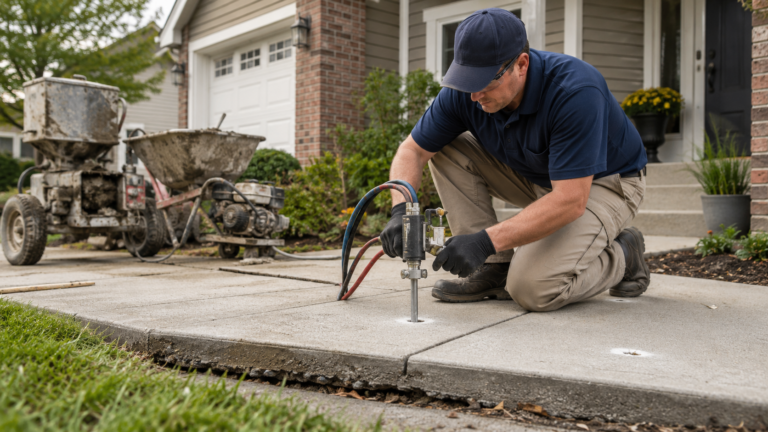
The process begins by drilling small holes into the sunken concrete slab. These holes serve as entry points for polyurethane foam, similar to how injection foam is installed. Once the holes are drilled, the foam is injected under the slab.
As the foam expands, it fills the voids beneath the slab and lifts it back to its original position. The foam then hardens, providing a stable base for the concrete. The drilled holes are then filled and sealed, leaving you with a smooth, level concrete surface.
One of the main advantages of concrete leveling over other methods is the speed of the operation. Most concrete lifting jobs can be completed in a matter of hours, with the concrete ready for use 15 minutes after installation.
How Polyjacking Works
Polyjacking works by injecting expanding polyurethane foam beneath a sunken slab through small holes drilled into the concrete. The foam fills the void, consolidates the soil, and lifts the slab back to grade from the inside out.
Here is the step-by-step process:
- Holes are drilled through the concrete slab–typically no larger than a dime. The number and placement of holes depend on the slab’s size and the location of the void beneath it.
- A two-component polyurethane foam is mixed at the tip of an injection port and pumped under the slab through each hole. The two components react upon contact and begin to expand immediately.
- As the foam expands, it flows into voids, compacts loose or eroded soil particles, and exerts upward pressure that lifts the slab. The technician monitors the lift in real time, stopping injection when the slab reaches the target grade.
- The foam cures in approximately 15 minutes. Once cured, it is rigid, moisture-resistant, and load-bearing.
- Holes are patched with color-matched cementitious material and finished flush with the slab surface.
The surface is ready for foot traffic immediately. Vehicle traffic can resume within an hour.
A typical residential polyjacking job, such as a driveway panel or a sidewalk, is complete in 2 to 3 hours.
Schedule My Free Onsite Concrete Lifting Quote Today
Concrete Leveling vs. Mudjacking vs. Full Replacement
When it comes to repairing structurally sound concrete, polyjacking is the most cost-effective option and delivers the best long-term value.
The following table provides a breakdown of common concrete repair methods in NEPA to help you determine which is best for your budget and circumstances.
| Polyjacking (Polyurethane) | Mudjacking (Slurry) | Full Concrete Replacement | |
| Typical Cost | $3–$7 per sq ft (varies by scope) | $2–$5 per sq ft (lower upfront) | $6–$16 per sq ft plus demo/disposal |
| Time to Complete | 2–4 hours for most residential jobs | 4–8 hours | 1–3 days of work; 28 days full cure |
| Ready for Use | Foot traffic same day; vehicles in 1 hour | Foot/vehicle traffic after 24–48 hours | Foot traffic after 24–48 hrs; vehicles after 7–28 days |
| Disruption | Minimal—dime-sized injection holes; no heavy equipment on site | Moderate—larger 1-to 2-inch holes drilled; more cleanup required | High—concrete demo, disposal, forming, pour, cure, wait |
| Lifespan of Repair | Decades; completely waterproof and stable | Temporary to moderate; prone to erosion and settling | Decades—but same soil problem recurs without treatment |
| What It Fixes | Voids and settlement beneath a structurally sound slab | Voids and settlement beneath a structurally sound slab | Concrete that is crumbling, broken, or too thin |
| Weight Added to Soil | ~2 lbs/cubic ft of foam—effectively none | ~100 lbs/cubic ft—adds massive stress to weak soil | Full slab weight of new concrete—~150 lbs/cubic ft |
| Environmental Impact | No demolition waste; reuses existing slab | Natural materials; reuses existing slab | Old concrete to landfill; new production carbon cost |
Schedule My Free Onsite Concrete Lifting Quote Today
Scenarios When Concrete Leveling Is Worth It in NEPA
Concrete leveling is the right choice when the concrete itself is structurally intact but has settled due to shifting, erosion, or collapse of the supporting soil.
The following applications benefit the most from polyjacking and save homeowners the most money.
Driveways
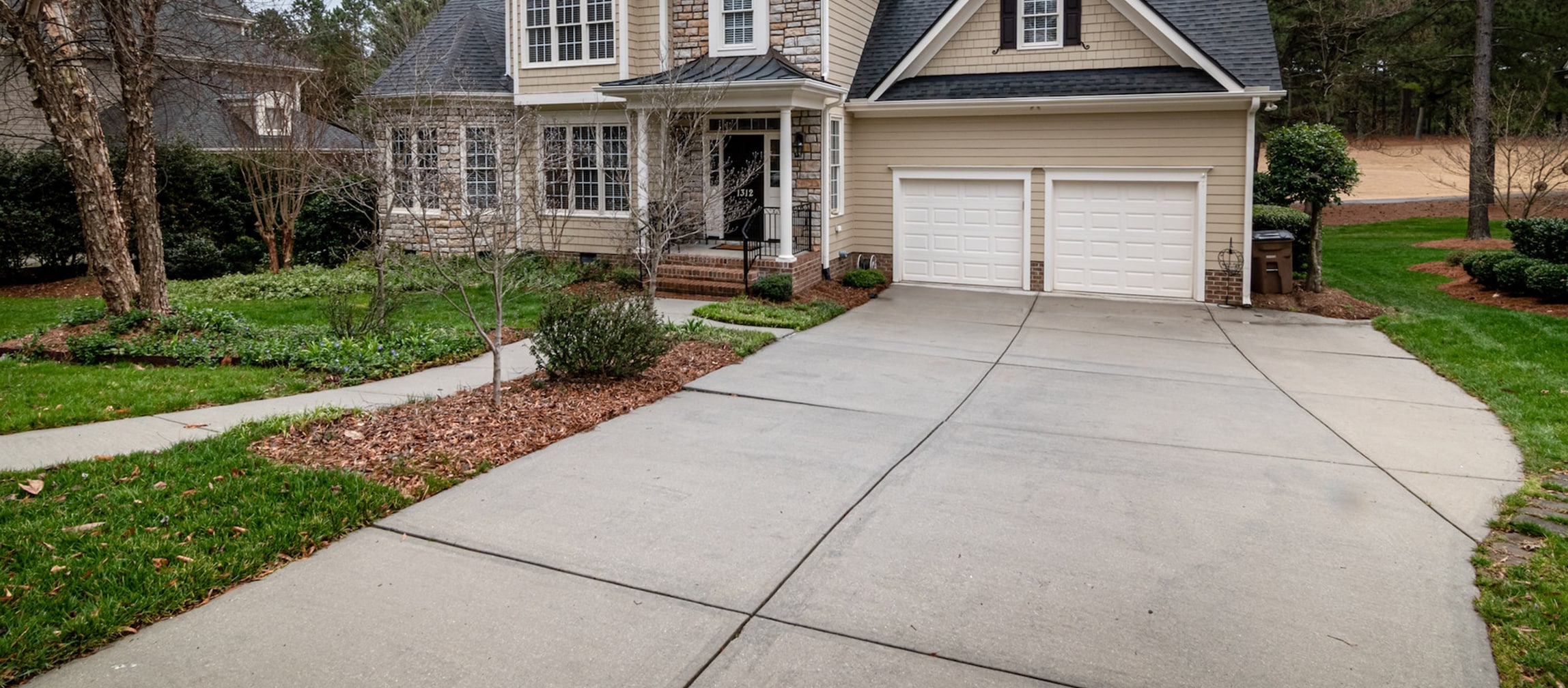
A concrete panel that has settled an inch or two relative to adjacent panels creates a trip hazard and allows water to pool, further accelerating settlement by channeling water directly toward the problem area. Concrete leveling restores the drainage slope and eliminates the trip edge, creating a smooth driveway surface that looks as good as new.
Sidewalks and Front Walks
Raised or sunken sidewalk panels create a liability risk, and in municipalities where homeowners are responsible for the public walk abutting their property, a cracked slab can result in a notice of violation. Polyjacking a lifted sidewalk panel takes under an hour and returns the walk to code-compliant grade without the permit delays.
Patios
When a backyard patio sinks, it usually pulls away from the house. This leaves a gap at the foundation line that channels rainwater straight down against your basement walls. Leveling the patio does more than just make your outdoor living space look good again—it restores the proper slope so rainwater drains away from your home, keeping your foundation dry.
Garage Slabs and Basement Floors
Interior concrete floors in garages and basements settle when the soil underneath packs down or when water washes away dirt through cracks in the slab. A sloping garage floor causes drainage issues and can actually let cold air sap heat from your home through the unsupported edges of the slab. Polyjacking is an easy, clean fix for indoor floors, raising them back to level in a few hours without leaving a dusty construction mess behind.
Settling Concrete Near Foundations
If your front stoop, steps, or concrete landings are leaning away from the house, it is a major red flag. In Northeast Pennsylvania, a sinking stoop is often the first visible sign that the soil right next to your foundation is shifting or washing out. Leveling the steps eliminates the immediate trip hazard, while injecting foam beneath fills the hidden voids to stabilize the ground and protect your home’s structure.
Schedule My Free Onsite Concrete Lifting Quote Today
Scenarios When Replacement Is Recommended
You should replace the concrete rather than leveling it if the concrete slab has structurally failed, is crumbling, or has broken into multiple displaced pieces. Concrete leveling can only fix displaced concrete; it cannot repair structurally compromised material.
The following scenarios are when we usually recommend replacing a slab or when polyjacking will be ineffective as a repair method.
- The slab is broken into multiple, displaced pieces: Shattered concrete lacks the structural integrity to be lifted as a single unit, and injecting foam can actually push the broken pieces further apart.
- The surface is crumbling, spalling, or peeling: Lifting a slab that is already flaking and deteriorating from freeze-thaw damage or rusted rebar will not stop it from continuing to fall apart.
- The slab is too thin for the weight it carries: An undersized slab (like a 3-inch driveway) will simply crack again under heavy vehicle traffic, even after it is leveled.
- There is active foundation movement: If the concrete is sinking because your home’s foundation is shifting, leveling is just a temporary band-aid until a structural engineer fixes the main foundation issue.
- The settlement gap is too large to bridge safely: Slabs that have dropped 4 or more inches require massive volumes of foam and are usually better candidates for a full replacement assessment.
Why Concrete Sinks in NEPA: Freeze-Thaw Cycling and Mine Subsidence
Concrete settling is very common across our region for two primary reasons: rapid freeze-thaw cycles and mine subsidence.
Northeast Pennsylvania experiences over 100+ annual freeze-thaw cycles that repeatedly expand and contract water beneath concrete slabs, progressively displacing the supporting soil and causing slabs to settle.
This damage is severely accelerated by winter road salt, which increases the frequency of these destructive cycles and aggressively deteriorates both the concrete and its subgrade.
Much of Northeast Pennsylvania also sits above 2,500 square miles of old, abandoned coal mines, which can cause the ground to gradually tilt and sink over time.
While polyjacking can easily restore these settled slabs to level once the ground has stabilized, you should contact the PA DEP Mine Subsidence Insurance Program first if you suspect active underground shifting.
Due to these factors and natural soil erosion that occurs due to rain and construction-related activity, it’s essential to repair sunken concrete as soon as possible to prevent further damage.
Concrete leveling is the most affordable and long-lasting concrete repair method for structurally intact concrete and it can be completed in a matter of hours and used immediately after curing.
Schedule My Free Onsite Concrete Lifting Quote Today
Frequently Asked Questions
What is concrete leveling?
Concrete leveling is a repair process that raises sunken or uneven concrete slabs back to their original position without removing them. Polyjacking drills dime-sized holes through the slab, injects expanding polyurethane foam beneath it, and patches the holes. The foam fills voids, consolidates soil, and lifts the slab. It cures in approximately 15 minutes, and the surface is ready to use the same day.
Is concrete leveling worth it in Northeast Pennsylvania?
Yes, for slabs that are structurally sound but have settled due to soil movement, concrete leveling costs 50 to 80 percent less than replacement and is done in hours. In NEPA, where freeze-thaw cycling, soil erosion, and mine subsidence are the primary causes of concrete sinking, polyjacking addresses the void beneath the slab. If the slab itself is crumbling, spalling badly, or broken into multiple pieces, replacement is the right call.
How does polyjacking work?
Polyjacking works by injecting expanding polyurethane foam through dime-sized holes drilled into a sunken slab. The two-component foam fills voids, consolidates soil, and lifts the slab as it expands. It cures in approximately 15 minutes. Holes are patched flush with color-matched material. The slab accepts foot traffic immediately and vehicle traffic within an hour.
What causes concrete to sink in NEPA?
In Northeast Pennsylvania, concrete sinks for three primary reasons: freeze-thaw cycling (100+ cycles per year displace support soil), underground water erosion (piping removes fine particles from beneath slabs), and mine subsidence (gradual settlement above abandoned mine workings in Luzerne, Lackawanna, Carbon, and Schuylkill Counties). All three create the same condition, a void beneath the slab that allows it to sink.
How long does concrete leveling last?
Polyurethane foam provides a decades-long service life when the underlying soil conditions are stable. In NEPA’s freeze-thaw environment, polyurethane significantly outlasts mudjacking because the foam is unaffected by freeze-thaw cycling, unlike cement-based slurry.