
Yes, for the right problem. When a slab or footing has settled because the soil beneath it eroded or compacted, polyurethane foam injection fills the void, lifts the concrete, and stabilizes it in hours at a fraction of the cost of piers. It is not a fix for structural failure or active mine subsidence, which need an engineer first.
Foundation symptoms tend to show up in cold weather. Doors that closed fine in September start to stick, hairline cracks widen, and a gap opens where a slab meets a wall, because frozen ground and dry indoor air both move a house that has already lost some of its support. This guide explains what makes foundations settle in Northeast Pennsylvania, how polyurethane concrete lifting works on foundations, how it compares with piers and mudjacking, what it costs, and where it is the wrong tool.
The focus here is foundations, footings, and slab on grade homes. If your problem is an interior basement or garage floor that tilts, our guide on how to level a sloped concrete floor covers that case in detail.
Schedule My Free Concrete Leveling Estimate Today
What Causes a Foundation to Sink in NEPA?
A foundation sinks when the soil beneath part of it loses volume or strength, and in Northeast Pennsylvania, four causes account for most of the settlement crews see. Erosion is the first. Roof water from short downspouts, poor grading, and leaking supply or drain lines carry fine soil away from the footing and from under slabs, a little with every storm. Poor compaction is the second, since backfill placed against a new foundation and fill placed under a slab keep consolidating for years if they were never packed properly.
Freeze-thaw cycling is the third cause. Water in the soil beside and beneath shallow concrete freezes, expands, and thaws more than 130 times in a typical NEPA winter, and each cycle loosens soil and opens gaps. The National Weather Service climate records for Scranton and Wilkes-Barre show a freezing season that stretches from fall well into spring. The fourth cause is specific to this region. Large parts of the Wyoming and Lackawanna valleys sit over abandoned anthracite workings and mine backfill, and that ground can keep compacting long after a house is built.
Most of these causes can be managed before they do damage. Our 7 tips to prevent foundation issues in a NEPA house cover drainage, grading, and the seasonal checks worth making, and our post on the 7 causes of sinking concrete in Northeast Pennsylvania explains each mechanism. Once a void has formed, though, the missing support has to be put back.
Schedule My Free Concrete Leveling Estimate Today
How Does Polyfoam Foundation Repair Work?
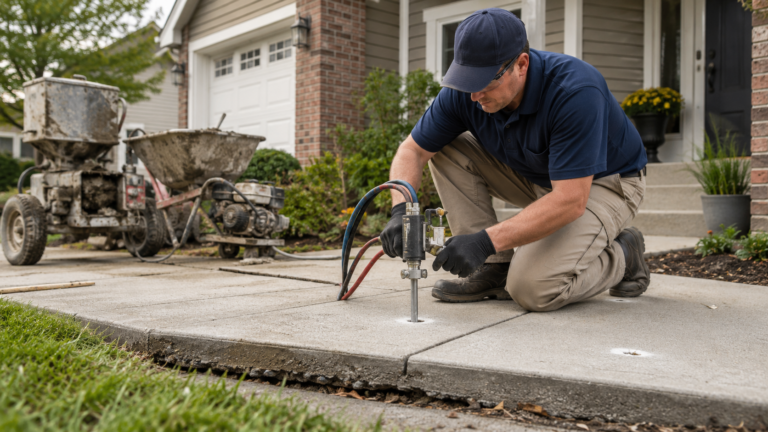
Polyfoam foundation repair works by injecting an expanding polyurethane foam into the void or loose soil beneath settled concrete, where it fills the empty space, tightens the surrounding soil, and lifts the concrete back toward its original position.
A technician drills 5/8 inch holes, each about the size of a dime, through the slab or beside the footing and injects the foam in measured amounts while watching the lift with a level. The foam cures in about 15 minutes, and the holes are patched with a cement-based compound.
Two properties make the material well suited to failing soil. The cured foam weighs about 2 pounds per cubic foot, so it restores support without adding meaningful load to ground that has already settled, and it is waterproof, so it does not wash out the way soil or cement slurry can. The same process handles void filling under slabs that have not yet dropped, which stops settlement before it becomes visible.
The honest limit is depth and load. Foam works where the problem is near the surface, which covers slab-on-grade foundations, basement and garage floor slabs, stoops, porches, and shallow footings that have lost soil to erosion. It does not transfer the weight of a building down to deep stable soil or bedrock. That is the job of piers, and the comparison below shows where each method belongs.
Schedule My Free Concrete Leveling Estimate Today
Polyfoam vs. Push Piers vs. Helical Piers vs. Mudjacking
Homeowners researching foundation repair will see four methods quoted. Two of them fill and lift from just below the concrete, and two of them carry the structure on steel that is driven or screwed down to deeper soil. The table compares them on the factors that decide which one fits.
| Factor | Polyurethane foam | Mudjacking | Push piers | Helical piers |
|---|---|---|---|---|
| How it works | Expanding foam injected through 5/8 inch holes fills voids and lifts | Cement slurry pumped under the slab through larger holes | Steel pipe sections driven hydraulically to load bearing soil | Steel shafts with helix plates screwed into stable soil |
| Cost | Lowest of the lasting options; about half of slab replacement | Lowest quote upfront, often repeated | High; priced per pier, several usually needed | High; priced per pier, several usually needed |
| Time | Hours | A day, plus 24 to 72 hours of curing | Days | Days |
| Disruption | Minimal; small holes, no excavation | Moderate; larger holes and wet slurry | Heavy; excavation at each pier along the wall | Heavy; excavation at each pier along the wall |
| Lifespan | Decades; waterproof and does not erode | About 3 to 5 years on settling soil | Permanent when driven to competent soil | Permanent when installed to design depth |
| Best use | Settled slabs, stoops, shallow footings, and voids from erosion | Low value slabs where a short term fix is acceptable | Heavy structures on deep weak soil | Lighter structures, additions, and porches on deep weak soil |
| Not suited to | Structural failure, deep bearing problems, active subsidence | Weak soil that cannot carry added weight | Problems that are only a shallow void | Problems that are only a shallow void |
The table points to a simple rule. When the concrete has dropped because the soil just beneath it is gone, foam is faster, cleaner, and far less expensive. When the bearing soil is too weak or too deep to trust, piers are the right repair, and a contractor who sells only one of the two shouldn’t be the one making that call. Our mudjacking vs. polyjacking comparison explains why the slurry method rarely holds up on NEPA soils.
Schedule My Free Concrete Leveling Estimate Today
When Is Polyfoam the Wrong Answer?
Polyfoam is the wrong answer when the structure itself has failed or when the ground is still moving, and saying so plainly is part of an honest estimate. Stair step cracks in block walls, horizontal cracks with a wall bowing inward, a footing that has dropped under a bearing wall, and upstairs doors and windows that have gone out of square all point to structural movement. Those call for a licensed structural engineer before any repair is chosen, and the engineer’s report determines whether piers, wall bracing, or another method is needed.
Active mine subsidence is the second case. The Pennsylvania Department of Environmental Protection’s mine subsidence risk tool shows whether an address sits over or near a known mined area, and Penn State’s Pennsylvania Mine Map Atlas displays the historic mine maps themselves. If the movement was sudden, is getting worse, or comes with a depression or hole in the yard, contact DEP before scheduling any contractor. DEP’s Mine Subsidence Insurance program has covered this kind of damage since 1961 at about 27 cents per $1,000 of coverage, because standard homeowners policies usually exclude it.
Two more situations call for a pause. An active plumbing leak under or beside the foundation must be repaired first, or the void will simply reopen. Concrete that is heaving upward from frost or expansive soil is not a void problem at all, and injecting foam beneath it makes matters worse. A short inspection usually separates ordinary settlement from these other causes.
Schedule My Free Concrete Leveling Estimate Today
How Much Does Foundation Repair Cost in NEPA?
Polyfoam repair is the least expensive lasting option, and for slabs it typically costs about half of tearing out and replacing the concrete. Pricing depends on the size of the settled area, the depth of the void, how much foam the lift requires, and access to the work area. A small stoop or a single settled corner sits at the low end, and a long run of slab or a large void sits higher. Our breakdown of concrete lifting costs in NEPA walks through those variables.
Piers are priced per pier, and most homes need several along the affected wall, plus excavation and often an engineered design. That is why a pier quote is normally many times the cost of a foam lift. The difference is justified when the structure needs deep support and wasted when it does not. The only reliable number comes from an onsite inspection, because two houses on the same street can sit on very different soil and have very different problems.
Schedule My Free Concrete Leveling Estimate Today
What Signs Should You Act on Now?
Act now on any sign that is new or getting worse, because cold weather speeds up the damage. The common early signs are doors and windows that begin to stick, cracks in drywall above door frames, a gap opening between a slab and a wall or between a stoop and the house, floors that slope, and cracks in concrete that widen from one season to the next. Water makes all of them worse. A void under a slab or beside a footing collects rain and snowmelt, that water freezes and expands, and the gap is larger by spring.
A simple way to judge urgency is to mark it. Put a pencil line and a date at the end of a crack, or measure a gap and write it down, and check again in a month. Movement you can measure is movement to have inspected. If the signs are limited to concrete that has dropped, lifting it restores support and drainage in a single visit. A stabilized, dry basement is also the starting point for basement insulation, which is one of the higher payback winter upgrades in a NEPA home.
EnergySmart lifts and stabilizes settled slabs, stoops, and shallow footings across Northeast Pennsylvania with polyurethane foam, and every project starts with a free onsite estimate that includes an honest answer about whether foam is the right repair. Contact us or call 570-558-0941 to have your foundation looked at before winter does more damage.
Schedule My Free Concrete Leveling Estimate Today
FAQs
Does polyurethane foam foundation repair work?
Yes, when the cause is a void or loose soil near the surface. The foam fills the void, lifts the settled concrete, and stabilizes it. It does not correct structural failure, deep bearing problems, or active mine subsidence.
How long does polyfoam foundation repair last?
Decades. The cured foam is waterproof and does not erode or compress, so it holds as long as the cause of the original void, such as a leak or poor drainage, has been corrected.
Is foam injection better than piers?
It is better for shallow voids and settled slabs because it is faster, less disruptive, and far less expensive. Piers are better when the bearing soil is weak or deep and the weight of the structure has to be carried down to stable ground.
How much does polyfoam foundation repair cost?
It depends on the size of the settled area, the depth of the void, and access. For slabs it typically costs about half of replacement, and it is normally a fraction of a pier quote. A free onsite estimate gives an exact figure.
How long does the repair take?
Most foam lifts are finished in a few hours. The foam cures in about 15 minutes, so the area can be used the same day.
Can foam lift a house foundation?
Foam lifts slab on grade foundations, floor slabs, stoops, and porches, and it stabilizes soil under shallow footings. It is not a substitute for piers under heavy bearing walls on deep weak soil.
What are the signs of a sinking foundation?
Sticking doors and windows, cracks above door frames, gaps between a slab and a wall or between a stoop and the house, sloping floors, and concrete cracks that widen over time. Stair step or horizontal wall cracks call for a structural engineer.
Will polyfoam fix mine subsidence?
No. Mine subsidence is ground movement from a collapsing mine void, and the ground may keep moving. Check the DEP mine subsidence risk tool and contact DEP before any repair.
What is the difference between settlement and subsidence?
Settlement is gradual sinking into a void created by erosion, compaction, or freeze-thaw, and it stops once the void is filled. Subsidence is movement of the ground surface caused by the collapse of an underground mine, and it can be sudden and progressive.
Can foundation repair be done in winter?
Often, yes. Polyurethane lifting is generally performed when temperatures are above roughly 40 degrees, and colder conditions are assessed case by case. Call to confirm scheduling for your project.